
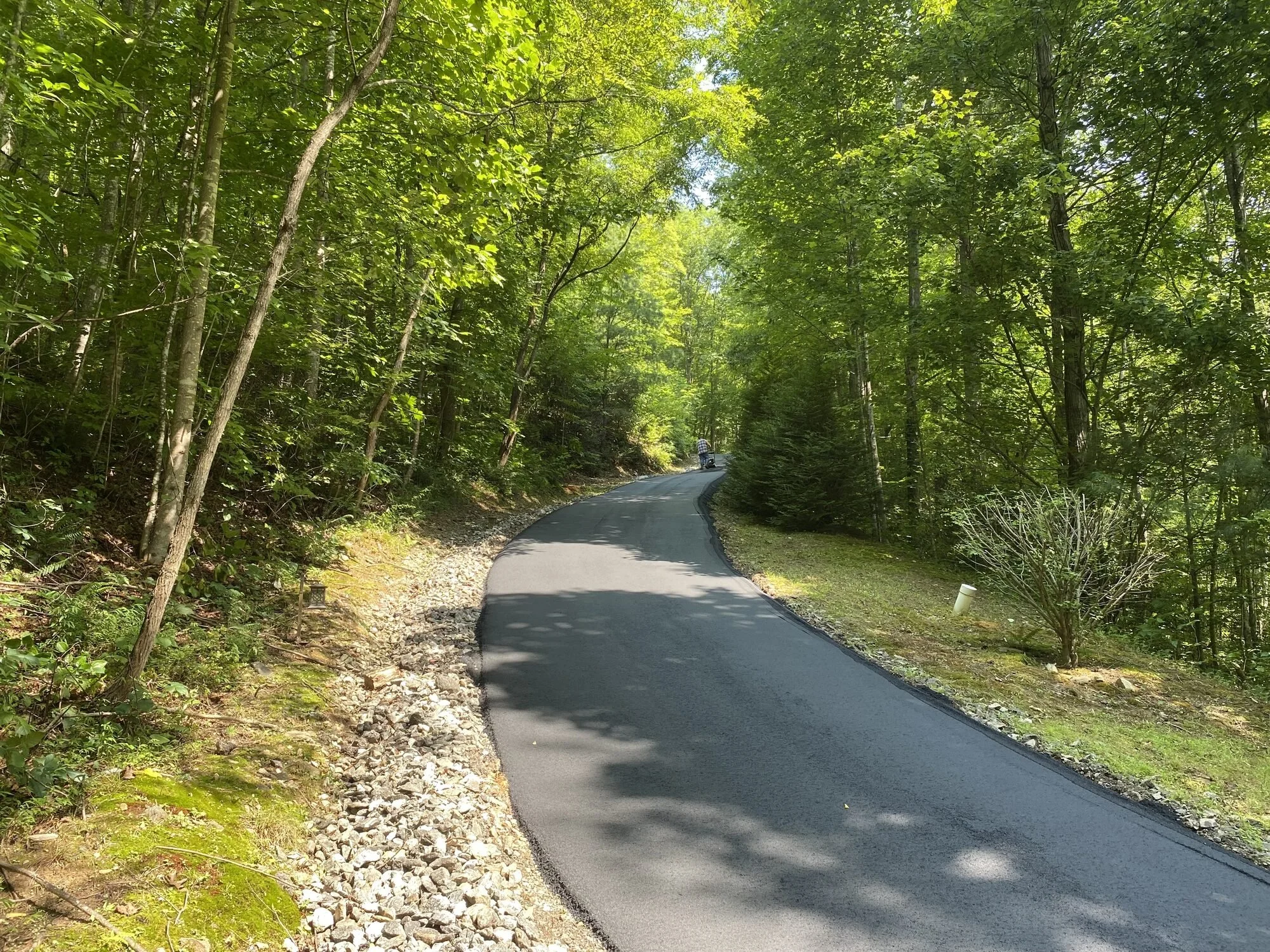
Asphalt Driveway Paving in Franklin, NC and Across the Mountains
A paved driveway in the mountains has a harder life than one in the flatlands. It climbs, it curves, it carries delivery trucks and propane tankers, and it sheds a lot of rain. For over 25 years Black Bear Paving has built asphalt driveways across Franklin, Highlands, Cashiers, Sylva, Bryson City, and Rabun County, Georgia, with our own crew, our own paver, and our own trucks.
Whether you're paving a new home site, paving over an existing gravel drive, or replacing asphalt that has reached the end of its life, we'll walk it with you and give you a written estimate at no charge. Call (828) 349-3390 or request a free estimate.
Asphalt Driveway Services
New Asphalt Driveways
From a cleared lot to a finished surface: we cut the route, build and compact the stone base, set the drainage, and pave. If your builder has already roughed in the drive, we check the base and the grade before any asphalt goes down.
Paving Over a Gravel Driveway
A gravel driveway that has carried traffic for a few years is often an excellent base for asphalt. We regrade it, correct the crown and drainage, add and compact stone where it's thin, and pave on top. It is usually the most economical route to a paved driveway.
Resurfacing & Overlays
If the asphalt is worn and weathered but the base underneath is still sound, a new layer over the old one can add years of life for less than a full replacement. We'll tell you honestly whether your driveway is a candidate. An overlay on a failing base only hides the problem for a season or two.
Removal & Replacement
When the cracking runs deep, with alligator patterns, heaving, or soft spots, the fix is to take out the old asphalt, repair the base, and pave new.
Extensions, Parking Pads & Turnarounds
Widening, extra parking, RV and boat pads, and turnarounds big enough for a delivery truck or fire engine, tied in cleanly to the existing pavement.
Patching & Repairs
Potholes, utility cuts, broken edges, and low spots that hold water, cut out and repaired properly instead of skimmed over.
How We Build a Driveway That Lasts
Nearly every driveway failure we're called to look at traces back to what is under the asphalt, or to water. That's where we put our attention.
Subgrade. We shape and compact the native ground and deal with soft or wet spots before any stone goes down.
Stone base. A compacted crushed-stone base carries the load. How thick depends on your soil and on what will be driving on it.
Drainage. Crown or cross-slope, ditches, culverts, and swales, so water leaves the driveway instead of running down it or sitting under it. See grading and drainage.
Asphalt. Hot-mix asphalt laid with a paving machine, not spread by hand, and compacted with a roller while it is still at temperature. Most residential driveways get roughly two to three inches of compacted asphalt; we specify yours on site based on the grade and how it will be used.
Edges and tie-ins. Clean transitions at the road, the garage, and the walks, and supported edges that don't break away.
Paving Steep Mountain Driveways
Steep is normal here, and it changes how a driveway has to be built. Water picks up speed on a grade, so it has to be turned off the driveway at intervals rather than allowed to run the full length. Switchbacks need enough width and radius for the vehicles that actually use them. The paver and roller have to be worked with the slope, not against it. And where a driveway meets a state road, both North Carolina and Georgia require a DOT driveway permit. This is the work we do day in and day out, and we'll tell you up front if part of your route should be regraded before it's paved.
Asphalt or Gravel?
Asphalt costs more up front and less to live with. It doesn't wash, rut, or need regrading. It is far easier to plow and to walk on, and it keeps dust and mud out of the house and off the cars. Gravel costs less to install and is simple to repair, but on a slope it needs regular attention. Many owners do it in two steps: build a good gravel driveway now, let it settle under traffic, and pave it later. We do both, so you'll get a straight answer about which makes sense for your property and budget.
What Affects the Cost of an Asphalt Driveway
We price driveways on site because no two are alike. The main drivers are length and width; how much grading and base work is needed; drainage and pipe; slope and access for trucks and the paver; whether old pavement has to come out; and the haul distance from the asphalt plant. Asphalt prices also move with the price of oil, so an estimate is good for a set period. You'll get a written estimate that spells out exactly what is included.
When to Pave
Hot-mix asphalt needs warm enough ground and air to compact properly, and the asphalt plants in our area shut down for part of the winter. Paving season in the mountains runs roughly from spring through late fall. Grading and base work can often be done over the winter so you're ready to pave as soon as the plants reopen. If you want a driveway paved in spring, the time to get on the schedule is now.
After Your Driveway Is Paved
New asphalt stays soft for a while, especially in hot weather. Keep vehicles off it for a few days, avoid turning the steering wheel while the car is standing still for the first several weeks, and keep trailer jacks, kickstands, and dumpsters off it or on a board. Once it has cured, sealcoating every few years protects it from sun, water, and freeze-thaw. In winter, we can keep it open with snow removal and ice control.
Where We Pave Driveways
Based at 6456 Sylva Road in Franklin, we cover Macon County (Franklin, Highlands, Otto, Scaly Mountain), Sylva and Jackson County (Sylva, Cashiers, Cullowhee, Dillsboro, Whittier, Cherokee), Bryson City and Swain County, and Clayton and Rabun County, Georgia (Clayton, Dillard, Rabun Gap, Sky Valley, Mountain City, Tiger, Lakemont, Lake Burton, and Lake Rabun).
See finished driveways from Whittier, Bryson City, Cashiers, and Franklin on Our Work.
Asphalt Driveway FAQs
How much does an asphalt driveway cost?
It depends on the size, the grading and base work needed, drainage, slope, and access. Two driveways of the same length can be very different jobs, so we give free on-site estimates rather than per-foot guesses.
How long does an asphalt driveway last?
A well-built asphalt driveway on a good base commonly lasts 20 years or more with basic maintenance. The base and the drainage matter more than anything else.
Can you pave over my existing gravel driveway?
Usually, yes. A settled gravel driveway often makes a very good base. We regrade it, fix the drainage, add stone where it's needed, and pave over it.
Can a steep driveway be paved?
Yes. Most of the driveways we pave are on a grade. Steep driveways need careful drainage and the right equipment and technique, and occasionally a section has to be regraded first.
How soon can I drive on new asphalt?
Usually within a few days, depending on the temperature. We give you specific guidance when we finish the job.
How thick will the asphalt be?
Most residential driveways get roughly two to three inches of compacted asphalt over a compacted stone base. Driveways that carry heavy trucks get more. We specify it on site.
Do you pave driveways in the winter?
Paving depends on temperature and on the asphalt plants being open, so the season runs roughly spring through late fall. Grading, base, and gravel work often continue through the winter.
Do you pave driveways in Highlands, Cashiers, and Rabun County?
Yes. We pave throughout Macon, Jackson, and Swain counties in North Carolina and Rabun County, Georgia.
Ready for a Free Estimate?
Call (828) 349-3390 or request a quote online — we'll get right back to you.