
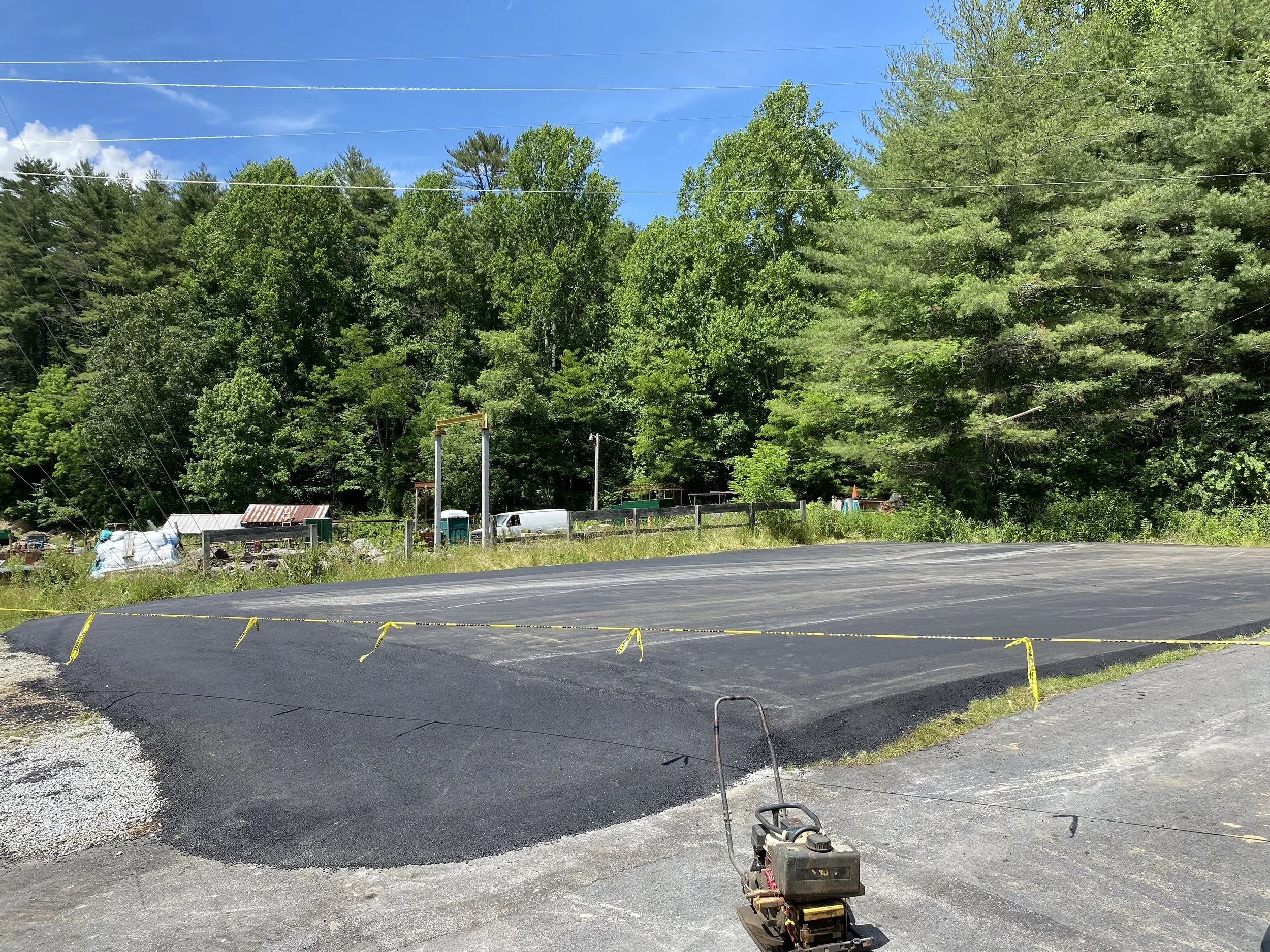
Asphalt Repair & Pothole Patching in Franklin, NC and Across the Mountains
Not every driveway or parking lot needs to be repaved. A lot of the asphalt we look at is basically sound and has a few bad spots: a pothole at the bottom of the hill, a crumbling edge where the shoulder washed out, a soft area where water has been getting into the base, a cut left by a utility crew. Fixed properly and early, those problems stay small. Left alone through a mountain winter, they spread.
Black Bear Paving repairs and patches asphalt for homeowners, businesses, HOAs, and property managers across Franklin, Highlands, Cashiers, Sylva, Bryson City, and Rabun County, Georgia. We do the repair work with the same crew, the same hot-mix asphalt, and the same compaction equipment we use to build new pavement, so a patch from us is built to last, not skimmed over. Call (828) 349-3390 or request a free estimate.
Asphalt Repair & Patching Services
Pothole Repair
We saw-cut the failed area back to sound pavement, remove the broken asphalt, repair and compact the base, and place and roll new hot-mix asphalt. The edges are sealed so water can't get back in. That's a full-depth patch, and it's the difference between a repair that lasts and a cold-patch fill that pops out by spring.
Alligator Cracking & Base Failure Repair
When an area of pavement has broken into a network of connected cracks, the base underneath has failed, usually because water got into it. Sealing over it doesn't work. We remove the asphalt, rebuild and compact the base, correct the drainage that caused the problem, and pave the area new.
Crack Sealing
Cracks are how water reaches the base. We clean them out and fill them with hot-applied rubberized crack sealant that flexes with the pavement through freeze-thaw. For most driveways and lots, this is the single highest-value maintenance item there is, and it pairs with sealcoating.
Edge & Shoulder Repair
Mountain driveways fail at the edges first, where water runs off the side and takes the shoulder with it. We rebuild broken edges, add stone to the shoulder so the pavement is supported, and regrade so runoff leaves the driveway without undercutting it.
Utility Cut & Trench Patching
After water, septic, power, or fiber work, we patch the trench properly: compacted backfill, stone base, and hot-mix asphalt tied into the existing surface, so there's no settled strip across your driveway or lot a year later.
Drainage Corrections
Standing water, a low spot that ices over, or a spot where runoff is undermining the pavement. We fix the cause along with the symptom: regrading, cutting in a swale, adding a drain or culvert, or redirecting a downspout. See grading and drainage.
Resurfacing & Overlays
When wear and cracking cover most of the surface but the base is still firm, an overlay is more economical than patching spot after spot. We repair the failed areas first, then pave a new layer over the whole thing. See asphalt driveways and parking lots.
Repair, Resurface, or Replace?
We'll give you a straight answer, and here's how we think about it.
Isolated potholes, a few cracks, broken edges, a utility cut: repair. Patch the spots, seal the cracks, and the pavement has years left in it.
Worn and cracked across most of the surface, but firm underfoot and draining well: resurface. Patch the bad areas and overlay the whole surface.
Alligator cracking over large areas, ruts, soft spots, or standing water that keeps coming back: the base has failed and that section needs to be rebuilt. Patching it would be throwing money at it.
Most driveways and lots are a mix, and the right plan treats each area for what it needs. We'll walk it with you, mark it up, and price the options so you can decide.
Why Mountain Asphalt Breaks Down
Water. With 70 to 90 inches of rain a year in parts of our area, water is behind nearly every asphalt failure we see. It gets in through cracks and unsupported edges, soaks the base, and the base loses its strength.
Freeze-thaw. Water in the pavement freezes, expands, and pries cracks open a little wider every night it drops below freezing. By spring a hairline crack is a pothole.
Slope. On a grade, runoff moves fast and carries grit that wears the surface. Steep sections take extra stress from braking, turning, and plowing.
Age and sun. Asphalt oxidizes. Twelve-year-old pavement that has never been sealed is brittle and cracks under loads it used to handle easily.
Repairs that address the water are the ones that last. That's why we look at drainage on every repair call, even a single pothole.
How We Patch
Saw-cut. Clean, square edges back to sound pavement. Ragged edges don't bond and don't last.
Remove and excavate. The broken asphalt comes out, and we dig to the depth needed to fix the base, not just the surface.
Rebuild the base. Compacted stone, with drainage corrected if water was the cause.
Tack and pave. The edges are tacked so the new asphalt bonds to the old, then hot-mix asphalt is placed and compacted with a roller.
Seal the joint. The seam between new and old is sealed so it doesn't become the next crack.
For Businesses, HOAs & Property Managers
A pothole in a parking lot or on an association road is a liability and a maintenance cost that only grows. We repair commercial lots and private roads on a schedule that keeps them open, and we can set up an annual maintenance visit: crack sealing, patching, and a drainage check each year, with sealcoating on the right interval. It is far cheaper than letting a lot deteriorate to the point of repaving. We also handle winter plowing and ice control for the same properties.
When to Repair
Hot-mix asphalt patching needs the asphalt plants to be open and the weather warm enough to compact, so the main repair season runs from spring through fall. Crack sealing has a slightly longer window. Fall is the best time of all: repairs done now keep water out of the base over the winter, which is when the real damage happens. If you've got cracks or a pothole starting, don't wait for spring.
What Affects the Cost of Asphalt Repair
The size and depth of the repair, how much base work is needed, whether drainage has to be corrected, the number of areas, and access for the truck and roller. Small repairs carry a minimum because of mobilization, so it's worth having us look at everything on the property at once. We provide a written estimate at no charge, and we'll tell you honestly if a repair isn't worth doing.
Where We Repair Asphalt
Based at 6456 Sylva Road in Franklin, we cover Macon County (Franklin, Highlands, Otto, Scaly Mountain), Sylva and Jackson County (Sylva, Cashiers, Cullowhee, Dillsboro, Whittier, Cherokee), Bryson City and Swain County, and Clayton and Rabun County, Georgia (Clayton, Dillard, Rabun Gap, Sky Valley, Mountain City, Tiger, Lakemont, Lake Burton, and Lake Rabun).
Asphalt Repair FAQs
How much does it cost to repair a pothole?
It depends on the size and depth of the pothole, whether the base underneath needs rebuilding, and how many areas you have. Small repairs carry a minimum charge for mobilization, so we recommend having everything on the property done in one visit. We give free on-site estimates.
Can you patch my driveway or do I need to repave?
If the problems are isolated, patching is the right call. If the base has failed over large areas, with alligator cracking, soft spots, or standing water, a patch won't hold. We'll walk it with you and tell you which it is.
Will the patch match the rest of my driveway?
New asphalt is darker than aged asphalt, so a patch is visible at first. It weathers to match over a season or two, and sealcoating the whole surface after patching evens out the color right away.
How long does an asphalt patch last?
A full-depth hot-mix patch over a rebuilt base should last as long as the surrounding pavement. Cold-patch fills and skim repairs usually fail within a year, which is why we don't do them.
How soon can I drive on a repair?
Usually the same day or the next day, depending on temperature. We'll tell you when we finish.
Do you repair asphalt in the winter?
Hot-mix patching depends on the asphalt plants being open and the weather being warm enough to compact. We work the warm stretches, but the main repair season is spring through fall. Fall is the ideal time to get repairs done before winter.
Do you seal cracks?
Yes. Hot-applied rubberized crack sealing is part of nearly every repair job and is the best value in asphalt maintenance.
Do you do small jobs?
Yes. A single pothole or a washed-out edge is a normal call for us. If you're in the area, we'll fit it in.
Ready for a Free Estimate?
Call (828) 349-3390 or request a quote online — we'll get right back to you.